Making a system's most critical capability its most accessible
Safety-critical video evidence answered dispatchers' most important questions — yet it was fragmented across dashboards, each with its own viewer and conventions. We led discovery, modeled needs into a durable framework, designed a unified experience for web and mobile, and supported the team through implementation.
This was a commercial engagement delivered by the team behind This Waay. It is presented as relevant experience for public-systems work — not as a government contract reference.
Context
Vestige provides transportation logistics solutions, giving fleet managers a centralized view of vehicle status. In the second phase of the platform's redesign — following our initial discovery and redesign work across the application — the focus shifted to the media experience: the in-cab and road-facing video that anchors the system's value for evidence, safety, and driver performance.
Video functionality had grown organically across the platform. Media surfaced in several different dashboards, each with its own viewer, entry point, and conventions. Live streams lived apart from historical clips, individual videos lacked context, and finding footage of a specific moment required knowing exactly where — and how — to look.
We led a full discovery-to-design arc: auditing how media appeared throughout the product, studying patterns from adjacent industries, interviewing the people who depend on the footage, and translating those insights into modern concepts for both web and mobile.
We partnered with the Vestige team through discovery, definition, and design — building the needs models that framed the problem space and delivering concept designs the team engaged us to help carry into development.
Methodologies
- Functionality audit across all media surfaces
- Best-practice review of adjacent industries
- User interviews on media engagement and needs
- Mental-model and entity-relationship mapping
- Use-case and user-story framing
- Concept exploration for web and mobile
Deliverables
- Audit of every surface presenting media, with challenges and opportunities
- Current-state flow maps for key investigation paths
- Browse-versus-Investigate engagement model
- Prioritized dispatcher use cases and user stories
- Redesigned dashboard and asset-detail concepts
- Mobile media experience explorations
The system had the footage. Staff had the questions. The experience stood between them.
For dispatchers and fleet managers, video answers the questions that matter most: What happened? Is my driver okay? What do I need to plan for tomorrow? But the experience of getting to that answer was working against them.
The functionality audit made the pattern visible across every surface:
- Media was reachable from multiple dashboards, each via a different path and viewer
- Live streams were separated from historical footage, with different players and no shared context
- Search assumed staff already knew the asset, date, and time — there was no way to browse what mattered
- Events and history were split apart, and clips lacked the context to signal which ones were important
- On mobile, reaching any media took several taps, with no access to live video at all
The task was to unify a fragmented set of media surfaces into one coherent experience — without losing the investigative depth that experienced staff relied on.
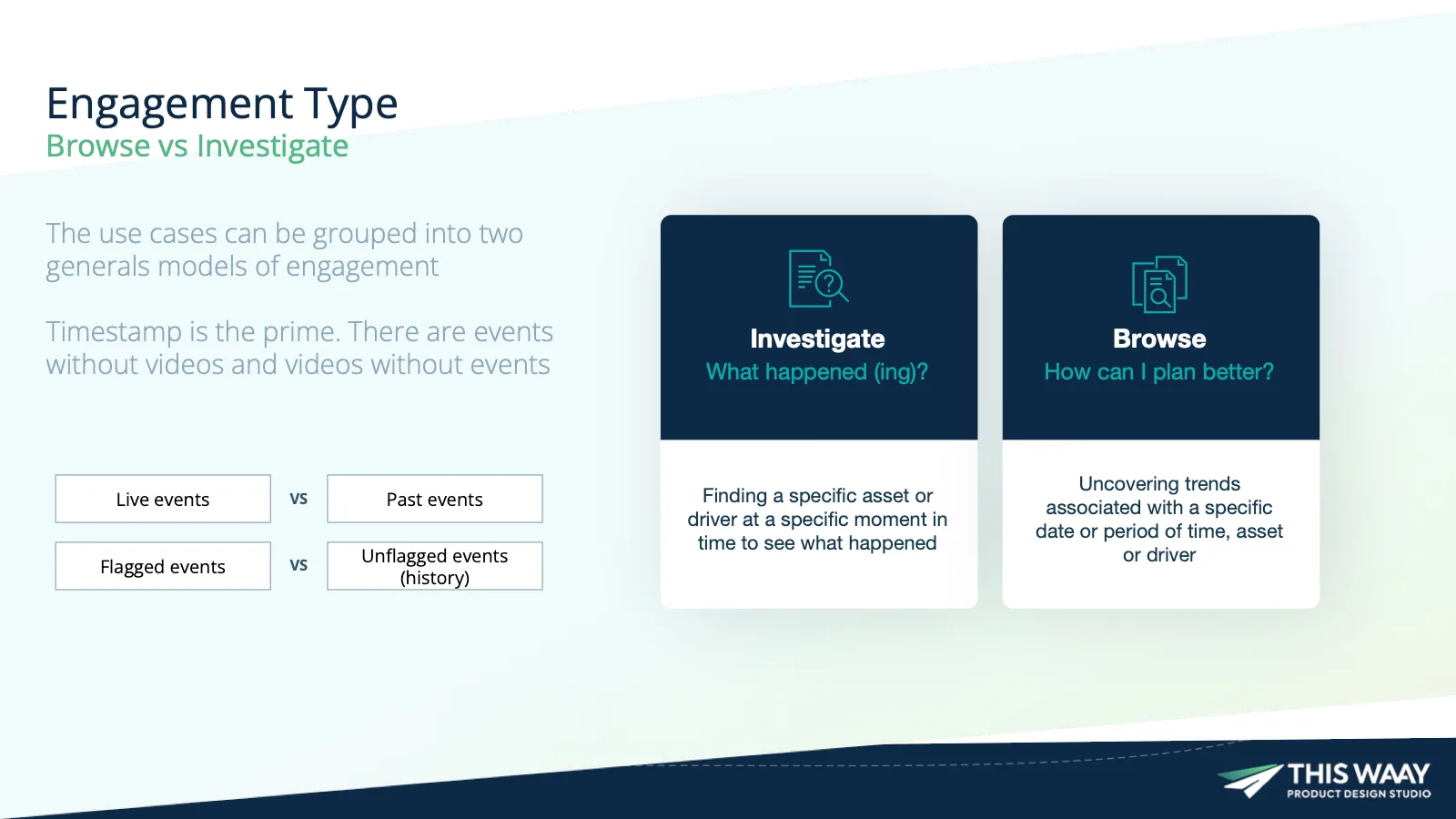
Every use case reduced to one of two modes: investigating a moment, or browsing for patterns.
We paired the internal audit with a best-practice review of systems that handle event video well — monitoring and security platforms with mature multi-camera and timeline experiences — and interviewed the people who depend on the footage about how media fits their real workflows.
The definition work distilled everything into models the team could design and prioritize against:
- A mental model mapping the relationships between assets, drivers, events, and media — revealing the natural entry points to each
- The Browse vs. Investigate framework — "What happened?" versus "How can I plan better?" — which became the organizing principle for the entire experience
- Prioritized dispatcher stories, from collecting evidence of an unflagged event to assessing driver performance to supporting a driver in real time
Mapping the current flows against those stories quantified the friction: reaching a single piece of relevant footage could take five or more steps across multiple dashboards.
One timeline, one viewer, and video where staff already are.
The concepts unified the media experience around the models from discovery:
- An asset panel on the mapping dashboard surfacing live video, today's events, and key details the moment an asset is selected — no more hunting through menus
- A timeline-based asset view unifying events, history, and media into one navigable stream
- A unified viewer treating live and historical footage as one continuous experience
- Browse and investigate entry points — contextual surfacing of recent and flagged events alongside precise search for specific moments
- A modern mobile experience with live streams, event timelines, and clip access designed around how dispatchers actually work away from their desks
Each concept connected staff needs to the system's purpose: making evidence easier to reach makes the service's core value impossible to miss.
From evidence through delivery — continuity that protected the investment.
- A shared, durable framework — Browse vs. Investigate — that continues to guide media decisions beyond the project
- Concept designs connecting staff needs directly to the system's core purpose
- Dramatically shorter paths to the footage that matters, on both web and mobile
- Continued partnership through implementation, supporting development and feasibility questions as the enhancements were built
By anchoring the redesign in how staff think — assets, drivers, events, moments in time — rather than how the system stored data, the most valuable capability became the most accessible one.
Evidence systems only serve the public when staff can reach the evidence.
Public-safety, transit, and fleet operations all run on evidence systems — footage, records, and event data that answer urgent questions. When reaching an answer requires institutional knowledge and five steps across multiple dashboards, the system is quietly failing the people it exists to serve.
The fix starts with a model, not a mockup: understanding whether staff are investigating a moment or browsing for patterns gives every subsequent design decision a foundation. And staying engaged through implementation is what turns concepts into working service improvements.
More engagements that show how we work.
Let's find the signal.
Does your team's most important capability take too many steps to reach? Let's model how your staff actually work — and design the shorter path.
Start a conversation →