Modernizing a mission-critical operations platform without a rebuild
JAMS, a workload-automation platform trusted to run mission-critical processes, had grown in capability faster than clarity. We researched three distinct staff roles, systematically evaluated the highest-value workflows, and delivered phased, evidence-based recommendations the team could act on immediately.
This was a commercial engagement delivered by the team behind This Waay. It is presented as relevant experience for public-systems work — not as a government contract reference.
Context
JAMS is a workload-automation platform that operations teams rely on to orchestrate mission-critical processes — from financial transfers to inventory management to large-scale data pipelines. Precision and uptime are non-negotiable.
As the product modernized its web experience, the team wanted more than a visual refresh. They wanted to understand where the experience slowed staff down, obscured system status, or demanded institutional knowledge — and how to fix it without disrupting the infrastructure organizations depend on.
Over eight weeks, we moved from discovery through definition to design: building a shared understanding of the platform's three staff roles, systematically evaluating its most critical workflows, and delivering concept designs the team could act on immediately.
We partnered with product and engineering leadership to lead discovery, heuristic evaluation, and design concept development across the platform's highest-value workflows — establishing a phased path to a modern, trustworthy experience without a foundational rebuild.
Methodologies
- Persona development and staff context gathering
- Workflow decomposition and mental-model mapping
- Heuristic evaluation across prioritized user stories
- Comparative landscape review
- Design concept development and validation planning
- Cross-functional product and engineering alignment
Deliverables
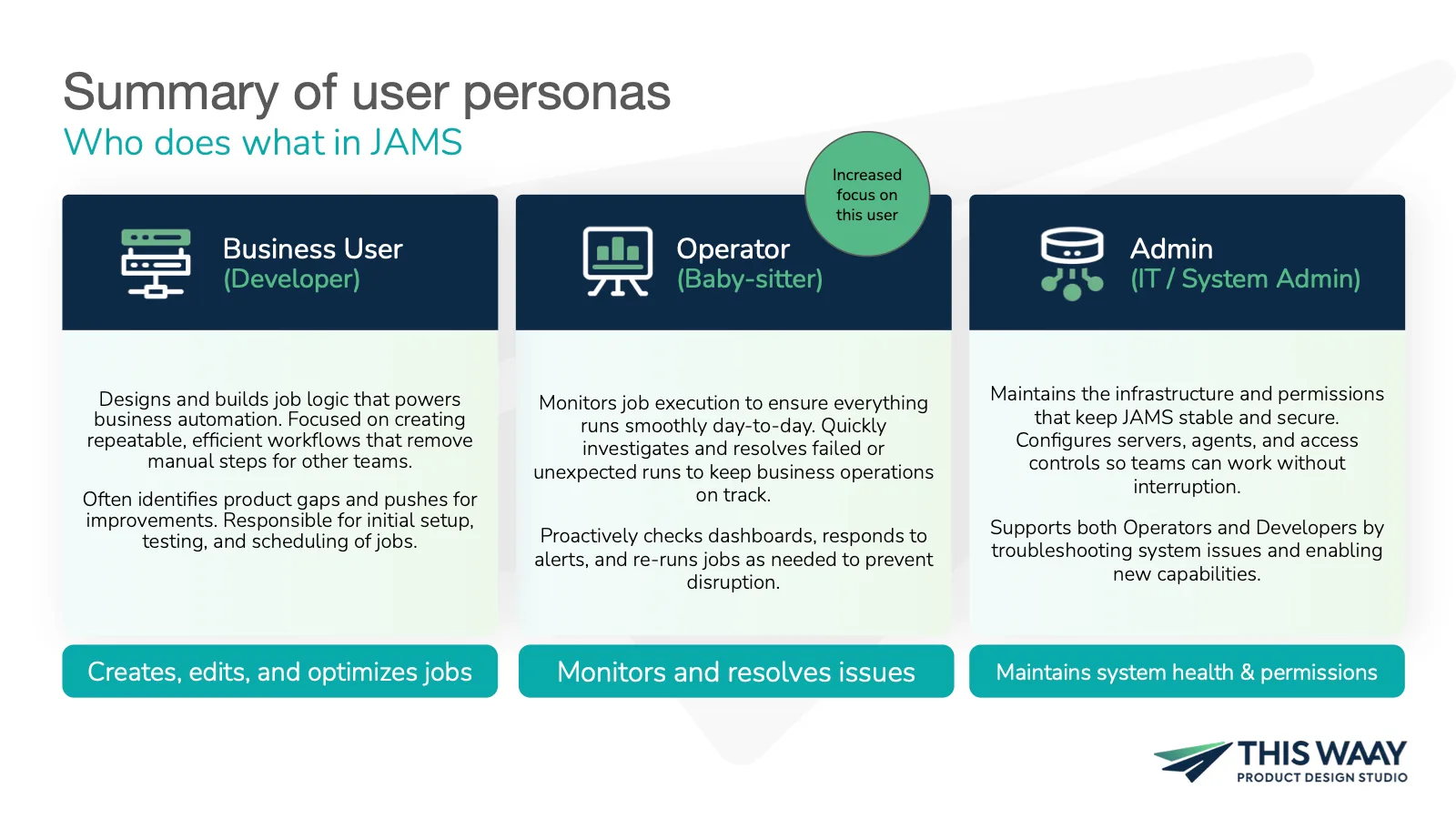
- Persona set covering developers, operators, and administrators
- Workflow-phase and mental-model artifacts
- Prioritized findings, separated into near-term improvements and structural opportunities
- Design concepts for the highest-value workflows
- Responsibly scoped AI-assistance recommendations
- Phased implementation roadmap aligned to the release plan
The platform's power had grown faster than its clarity.
JAMS supports three very different staff roles: developers who build automation logic, operators who monitor daily execution, and administrators who keep the environment stable and secure. Each depends on the platform in a different way — and each was encountering friction in a different place.
With more than 60 job types, deeply configurable scheduling rules, and dense monitoring views, everyday questions had become surprisingly hard to answer: Where is the job I'm looking for? Is this error something I should worry about? What should I do next?
The team was already investing in a modern web client. The risk was spending that investment on a facelift — reproducing existing friction in a newer visual style.
The task was to identify the improvements that would genuinely change how work gets done, and sequence them so the team could deliver value without pausing its release plans.
Before evaluating a single screen, we built a shared picture of who does what — and why.
Working closely with the product team, we developed detailed personas for the platform's three core roles — capturing their goals, behaviors, expectations, and the specific frustrations that slowed them down. We mapped the phases of work across the platform — configure, create and manage, monitor, troubleshoot — and modeled the mental model of the system's central object: its sequences, properties, schedules, triggers, and rules.
These artifacts did more than inform our evaluation. They gave the team a durable vocabulary for prioritization:
- A clear view of which staff role each improvement serves
- A shared understanding of where workflows hand off between roles
- A structural explanation for why certain areas felt confusing
A focused review of neighboring platforms rounded out the picture, highlighting where industry patterns had moved ahead of the current experience.
We evaluated the platform the way its staff experience it — one critical workflow at a time.
Rather than auditing screens in isolation, we structured the heuristic evaluation around prioritized user stories: monitoring job flow and system health, diagnosing and fixing failures, creating new jobs, and maintaining existing ones.
The findings separated cleanly into near-term improvements — pagination, sorting, action placement, navigation consistency — and deeper structural opportunities. We translated the highest-value opportunities into concrete design concepts:
- A unified home view giving every role an at-a-glance picture of system health and a guided starting point
- A more scannable monitoring view that promotes actionability
- A dynamic, guided job-creation experience with relevant type selection
- A true job summary that surfaces the context staff actually need
- A consistent visual language across the platform's builder and diagram views
Each concept was designed to respect the existing information architecture — improvements the team could phase into their current build, not a parallel redesign competing with it.
Phased, evidence-based recommendations the team could act on immediately.
- Near-term improvements folded directly into in-flight builds
- Larger concepts scoped with natural first milestones for the upcoming release
- A validated backlog of future work, from universal search to guided job creation
- Durable discovery artifacts that continue to anchor prioritization in a shared understanding of staff and workflows
The engagement also identified where intelligence could responsibly accelerate work — in troubleshooting and job creation. Those opportunities became dedicated follow-on efforts, covered in the companion case studies: embedding intelligence in a trusted system and AI as a structured accelerator.
Government runs on systems exactly like this one.
Staff-facing platforms in the public sector share this profile: powerful, dense, mission-critical, and dependent on institutional knowledge. When modernization budgets arrive, the risk is the same too — a visual refresh that reproduces old friction in a newer style.
A structured discovery effort — personas, workflow analysis, systematic evaluation — keeps modernization investment anchored to how staff actually work. Weeks of evidence, not quarters, is what separates a modernization from a facelift.
More engagements that show how we work.
Let's find the signal.
Planning to modernize a system your staff depend on every day? Let's find the improvements that genuinely change how work gets done.
Start a conversation →